The Most Common Online Scams in 2025 — and What to Watch in 2026
A data-backed look at the most common online scams seen in 2025 and the scam patterns consumers should watch more closely in 2026.
Online scams rarely stay still for long. The names change, the channels shift, and the language becomes more polished, but the basic mechanics often remain the same: trust, urgency, pressure, and confusion. What changed in 2025 was the scale of those tactics and the way they appeared across more platforms at once.
A person might first encounter a scam on social media, move into a messaging app, receive a polished website link, speak to someone who sounds professional on the phone, and then be pushed toward a transfer or wallet payment. By the time doubts appear, the trail is already spread across several devices and several channels.
That is why looking at scam trends matters. It helps people understand not only which categories caused the most harm, but also what kinds of patterns are likely to become even more common in 2026.
Investment-style scams remained one of the biggest high-loss categories
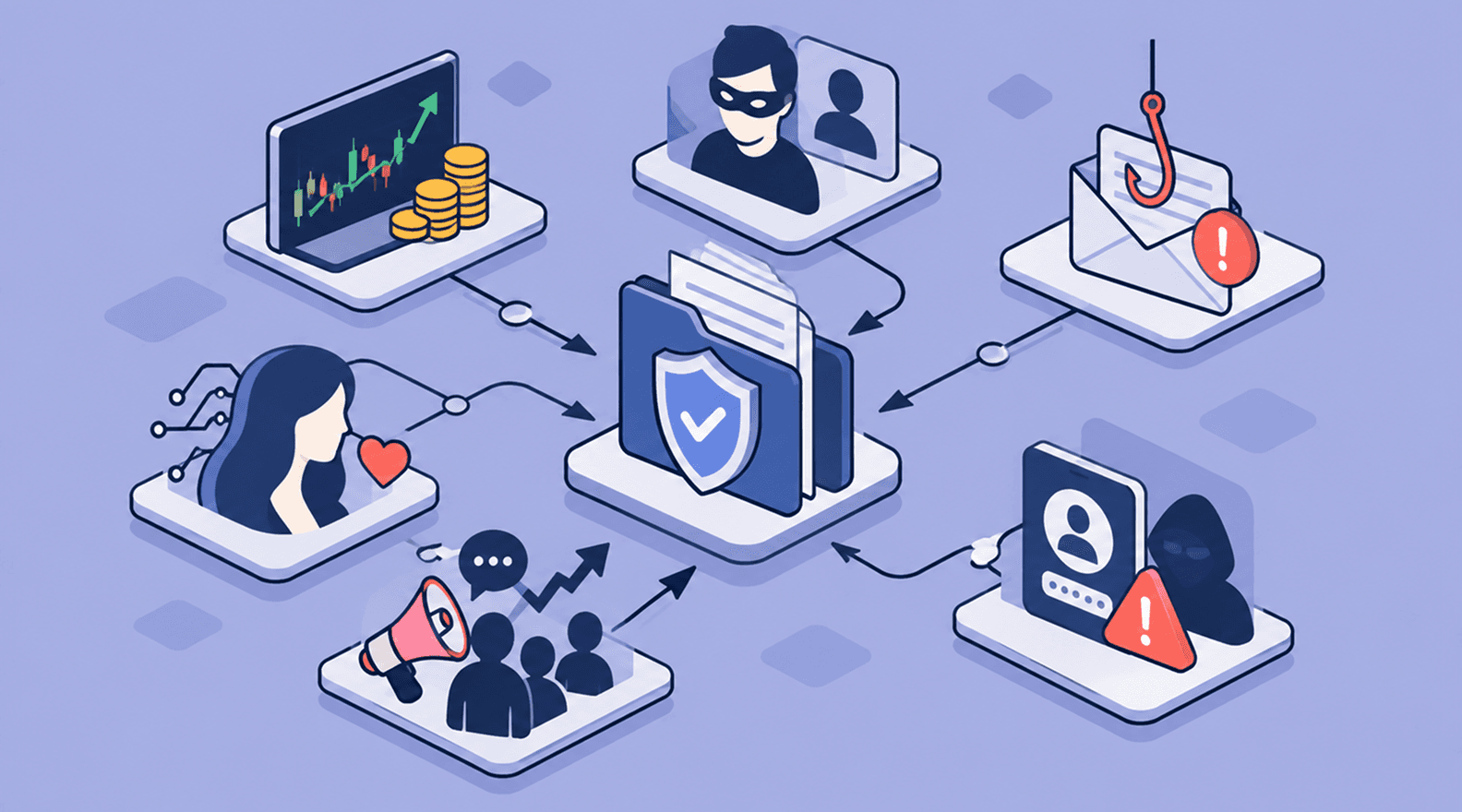
One of the clearest patterns behind the numbers is that investment-related scams continued to produce some of the heaviest losses. These schemes often relied on trading dashboards, false account growth, professional-sounding account managers, and repeated explanations about why more money was needed before withdrawals could happen.
In many cases, the setup followed a familiar structure. Deposits were easy. Communication felt strong at first. The platform appeared active and profitable. But when the user tried to withdraw, the process suddenly became conditional.
That combination of visible balance growth and blocked access remains one of the most important warning signs to watch.
Imposter scams kept growing because trust can be borrowed
Another major pattern in 2025 was the continued strength of imposter scams. These schemes work because they do not have to build trust from scratch. Instead, they borrow it. A scammer poses as a bank representative, government official, police officer, platform support agent, family member, or business brand and uses that borrowed credibility to push the target into fast action.
The emotional trigger may be fear, urgency, embarrassment, or obedience to authority. But the structure is often similar: an urgent problem is introduced, the target is told immediate action is needed, and the solution involves sharing information, moving funds, or following instructions before there is time to think clearly.
Phishing and spoofing stayed common because they are adaptable
Phishing and spoofing continued to matter not only because they are widespread, but because they adapt easily. A phishing message can imitate a bank, a delivery company, a login page, a support ticket, or even a known contact. Spoofing can make a call, message, or email appear more trustworthy than it is.
These scams do not always aim for an immediate payment. Sometimes the goal is account access, identity information, or a foothold that leads to later fraud. That is one reason they remain so dangerous.
Account takeover fraud became more visible
One pattern that deserves more attention going into 2026 is account takeover fraud. Once a criminal gains access to a person's bank, payroll, email, mobile, or financial services account, the consequences can spread quickly. The direct loss matters, but so does the chain reaction that can follow through identity misuse, unauthorized transfers, or locked-out access.
This is part of a broader shift in scam behavior. More operations are no longer focused only on the first fraudulent interaction. They are aimed at taking control of an account or identity and using that access in stages.
AI is making scam presentation more convincing
Another major development is the role of AI in making fraud more scalable and more believable. The core scam logic is not new, but the presentation is changing. Messages can sound more polished. Fake profiles can look more realistic. Impersonation can become more persuasive. Scam operations can test many variations faster and refine what works.
That does not mean every suspicious interaction is powered by advanced AI. It does mean that people should expect more convincing language, more realistic identity presentation, and more personalized manipulation in 2026.
Stock-manipulation and group-led hype schemes also deserve attention
A more specific trend to watch is investment fraud tied to social media groups, chat communities, or messaging-based hype cycles. In these cases, the victim may be guided toward a stock or trading move through coordinated promotion, fake confidence, or social proof inside a group environment.
These schemes can feel less like a direct scam at first because the pressure comes from a shared narrative rather than only one operator. That can make the manipulation harder to spot early.
What people should expect more of in 2026
The safest way to talk about 2026 is not to predict entirely new scam categories. It is to expect familiar scams to become more polished, more cross-platform, and more identity-driven.
That likely means more:
- impersonation built around trust in known institutions
- account takeover attempts linked to support or security claims
- highly polished investment-style scams
- AI-assisted fake profiles, messages, and outreach
- pressure to move fast across multiple channels at once
The scam itself may look different on the surface, but the pressure pattern underneath is often very similar.
Why documentation will matter even more
As scams become more layered, people may find themselves with evidence scattered across a browser, phone screenshots, email confirmations, platform dashboards, chat logs, and payment records. That makes preservation more important, not less.
In more complex cases, a structured report can help turn a scattered digital trail into a readable timeline with exhibits and supporting records. The goal is not to dramatize what happened. It is to make the case clearer and easier to review.
Final thoughts
The biggest lesson from 2025 is not that scammers invented entirely new tricks. It is that familiar scam models continued to evolve in presentation, speed, and credibility. Going into 2026, people should expect the same major scam families to become more convincing, more fragmented across platforms, and harder to evaluate in real time.
That makes early documentation, skepticism under pressure, and clear evidence preservation more important than ever.